
We've been helping Australians for 100 years
Lisa and Darrell Bossley are ready to help others – day in, day out. The Bossleys live beside a stretch of the Kings Highway that sits on the side of a mountain near Nelligen, in a remote part of the NSW south coast.
This article was originally published in March 2021 and has been updated.
Share this story:
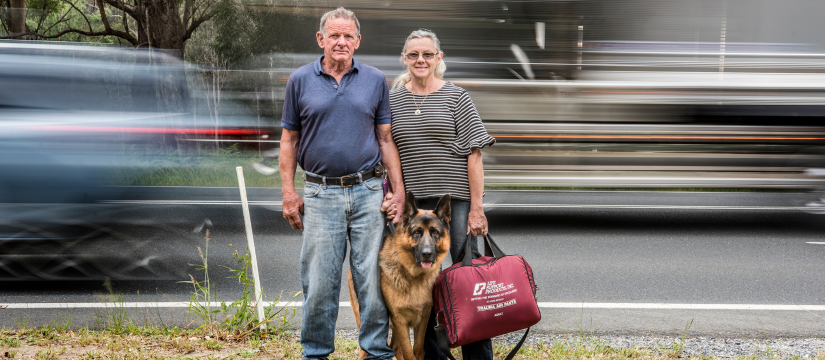
That stretch of road is known for its vehicle accidents. The Bossleys estimate there are 20 to 30 accidents each year near their property, Black Flat. For every one of them, Lisa and Darrell are there to help.
“This area is in a mobile blackspot,” says Darrell. “So we get a lot of people coming down our drive saying there’s been an accident, can they use the phone. We try to calm them down, get the details, help whoever needs it. We’ve had a few nasty ones.”
If both are home, Lisa – a former police officer and ICU nurse – heads straight up to offer medical assistance. Darrell stays to alert emergency services before helping with traffic control or taking his tractor up to move or stabilise vehicles in precarious positions.
The pair have a medical kit packed and ready to go every day.
Darrell, who has lived at Black Flat since 1988, and Lisa, who joined him there in 2003, have dealt with all kinds of accidents over the years, from minor crashes to a petrol tanker driving off the road.
In January, on a Sunday afternoon, a fatal crash highlighted the vital role they play in helping others. After hearing a crashing sound, Lisa discovered a car had driven off the road and down an embankment. She tried to flag down passing cars to ask them to call emergency services or alert her husband.
Traffic was busy with weekend travellers driving between Canberra and the coast, but no-one would stop. More than 50 cars drove past despite Lisa’s attempts to wave them down. “I even got down on my knees on the road pleading for them to stop,” she says.
A driver finally pulled up, allowing Lisa to reach the car. She found a barely conscious woman in a critical condition. After assessing her injuries, she knew her outlook was not good.
Lisa stayed with the woman for two hours, holding her hand, wiping the sweat from her face and talking with her. “I was telling her, ‘I'm here. I won't leave you’,” she says. “I could tell her that my husband’s alerted emergency services, they’re coming. I promised her I'd never leave her side and I didn’t. She was an amazing lady. Not once did she ever complain about any pain. Not once.”
The woman, who was travelling to see family members, died the following day. “I promised her that I would talk to her family,” she says. “That was really important to me. I fulfilled that promise. I felt that I had done everything I could for her.”
In the weeks that followed, Lisa – who received a Commendation for Brave Conduct in 2012 for helping two people saturated in fuel after a tanker overturned in 2004 – took time to help herself, too.
She and Darrell, a former blacksmith and martial arts expert, breed Friesian horses. They have seven horses at Black Flat. Their love for the medieval period has led to the pair participating in jousting tournaments, with Darrell wearing full medieval armour. They also run medieval skill-at-arms clinics, many for people with PTSD, anxiety or a disability.
Lisa and Darrell say they will always help others. That’s because in their situation and location, they believe no-one else will. Helping others, they believe, is to be human.
“Someone has to be there,” says Lisa. “Someone has to take responsibility. Someone has to care enough to give that person a chance. And someone has to pass on the story of what happened to that person.”
After the fatal accident, the woman’s family visited the Bossleys at Black Flat. “I could pass on to her children what their mum and I talked about,” says Lisa. “Knowing that their mum was, at that point, conscious and that she had the ability to be able to still recall her children and have a conversation with me. That was very, very comforting to her partner and her kids.”
Information is current as at the date of publication and may be subject to change. All content on the NRMA Insurance Blog is intended to be general in nature and does not constitute and is not intended to be professional advice. It does not take into account your individual objectives, financial situation or needs. References to third-party organisations, products, services or brands on the NRMA Insurance Blog are for informational purposes only and do not imply any affiliation with or endorsement by NRMA Insurance, unless expressly stated otherwise.