
We've been helping Australians for 100 years
Learn how thunderstorms work and how to get prepared, including where to find alerts, ways to get your home ready and checking your insurance.
Share this story:

A thunderstorm is a weather event associated with rain, thunder and lightning. They're typically short-lived, lasting between 30 minutes to an hour1. A severe thunderstorm is more intense, producing strong winds, heavy rain, thunder, lightning, and in some cases, hail and even tornadoes. Severe thunderstorms can last for many hours and span across many regions. In Australia, thunderstorms can happen at any time of year, but they're especially common between September and March.
Thunderstorms occur when hot, humid air rises quickly to cooler parts of the atmosphere2,3. Cute, puffy cumulus clouds swell into large, dark cumulonimbus clouds. The moving air builds and precipitation (raindrops) start to fall. Air continues to cycle up and down, and it's in this stage you might hear thunder and see lightning. Eventually, when the downdrafts become stronger than the updrafts, the storm weakens and the clouds begin to dissipate.
3 things are needed to create thunderstorms:
From familiarising yourself with the Australian Warning System, downloading hazard-alert apps and readying your home, there are many things you can do to start preparing for thunderstorms.
The Australian Warning Systems (AWS) is our national warning system used to help you stay safe and aware during different weather events. They can appear on local agency websites and incident maps. For storms, you'll see a triangle with a cloud and lightning symbol in either yellow, orange or red to indicate the relevant warning level.
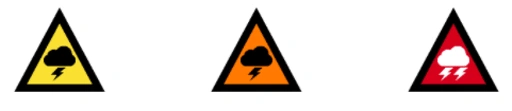
Image source: https://www.australianwarningsystem.com.au/
Advice: the yellow triangle lets you know that an incident has started, but there's no immediate danger.
Watch and act: the orange triangle lets you know that there's a heightened threat level. Conditions are changing and you need to start taking action to stay safe.
Emergency warning: the red triangle is the highest level of warning, altering you to danger and imploring you to act immediately.
In addition to listening to your local radio and news programs for weather updates and alerts, you can also:
Here are some state-based resources we've pulled together to help you get started:
In the lead up to storm season, consider whether it's worth setting aside time to get your home ready for extreme weather. This might include:
Checking your roof for any broken or missing tiles, and arranging any necessary repairs.
Trimming tree branches around your home that could cause damage if they were to break and fall.
If a storm is forecast for the week ahead, or perhaps within a few hours' time, you might consider:
Securing or putting away outdoor furniture that’s likely to be damaged or blown away.
Moving your car under a carport or garage, or away from trees and powerlines.
Bringing pets indoors and keeping them away from windows.
Many home insurance policies offer cover for storm damage and other extreme weather, but it's important to check your specific policy to ensure you know exactly what you're covered for. Review any building, contents and landlord insurance policies you have and any exclusions or limits that might apply. If you're unsure of anything, contact your insurer.
Underinsurance is when your sum insured won't cover as much as you might expect. This can make a stressful time even harder. If you're underinsured, this might mean:
One way to help avoid underinsurance, is to check your sum insured on your insurance policy. This typically refers to the amount it would cost to repair, rebuild or replace your home or contents in the event they're damaged or destroyed by an extreme weather event (that's covered by your policy); check the cover you have matches what it would cost to rebuild your home and replace all your belongings. As materials and labour costs can change over time, consider reviewing your insurance cover at least once a year.
1 The Bureau of Meteorology. (n.d). Thunderstorms. https://www.bom.gov.au/resources/learn-and-explore/severe-weather-knowledge-centre/thunderstorms
2 UCAR. (n.d). How Thunderstorms Form. Centre for Science Education. https://scied.ucar.edu/learning-zone/storms/how-thunderstorms-form
3 Krider, E.P. (2026, July 20). thunderstorm. Encyclopedia Britannica. https://www.britannica.com/science/thunderstorm
Information is current as at the date of publication and may be subject to change. All content on the NRMA Insurance Blog is intended to be general in nature and does not constitute and is not intended to be professional advice. It does not take into account your individual objectives, financial situation or needs. References to third-party organisations, products, services or brands on the NRMA Insurance Blog are for informational purposes only and do not imply any affiliation with or endorsement by NRMA Insurance, unless expressly stated otherwise.