
We've been helping Australians for 100 years
Whether you need some extra packing space for your trip around Australia or have a lot of garden waste on your hands, box trailers are a great way to transport large or bulky items. Here, we break down the things you need to know for a smooth tow.
This article was originally published in November 2020 and has been updated.
Share this story:
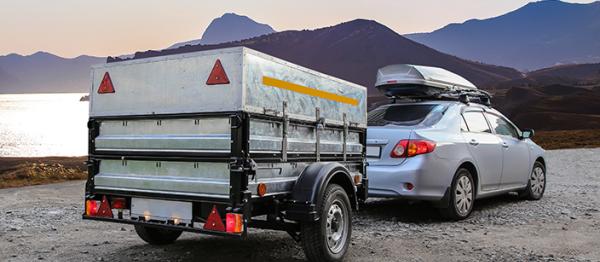
Did you know that each state and territory in Australia has specific rules on towing trailers and caravans? It’s good to acquaint yourself with these regulations before you head off, so here’s some helpful links to get your journey started:
NSW Government: Towing a trailer or caravan
Transport Victoria: Caravans towing rules
QLD Government: Towing vehicles and trailers
WA Government: Towing caravans, boats and more
SA Government: Towing and trailer regulations
Finding out how much your vehicle can safely tow, or how much weight your trailer can carry, is crucial to safe driving. Here’s a summary of the weights you need to be aware of:
This is the weight of your standard vehicle when it’s completely empty, except for all its fluids, such as coolants and oils, and 10 litres of fuel in the tank.
This is like the Tare Mass of your vehicle, but with a full tank of fuel and no accessories, like bull bars or roof racks, for example.
This refers to the maximum weight of the vehicle itself, including passengers, cargo, and accessories, but excluding any trailers or towed vehicles as specified by the manufacturer. You can usually find out your GVM on the inside of the driver’s door, or via the owner’s manual.
This is the maximum load your vehicle can carry. You find your payload out by deducting your Kerb Mass from your GVM, and that number will tell you how much stuff you can load into your vehicle.
This refers to the maximum weight that your front vehicle’s front and rear axles can carry.
This is how much an empty trailer weighs. Trailer can refer to anything you can tow or ‘trail’ behind a vehicle, such a single-axle box trailer, all the way up to multi-axle caravans.
As determined by your trailer’s manufacturer, this is the maximum axle load that your trailer is designed to carry.
You need to make sure that your tow bar is designed to suit your vehicle and its towing capacity. Your TBD should be around 10-15% of the GTM. You can use this formula to determine what's safe for your vehicle: TBD divided by GTM multiplied by 100. That will equal the safe percentage of your GTM.
This the GTM combined with the TBD.
When you’re towing a trailer, you need to find GCM. This is the total weight of the vehicle and trailer combined, as specified by the tow vehicle's manufacturer. It considers the maximum weight of the vehicle, the maximum weight of trailer, plus any additional load being carried by both the vehicle and the trailer.
There are a few different options for attaching a trailer to your vehicle, including a tow ball and hitch, a tow bar, and a fifth-wheel coupling. The best attachment for your vehicle will depend on the size and weight of the trailer and your vehicle’s towing capacity.
In Australia, these hitch types are commonly used because they’re well priced, easy to use, and work well for most applications. However, because they don’t move up, down or side to side freely with your vehicle, they aren't generally suited for going off-road. This attachment is suitable for small to medium sized trailers.
These hitches fully articulate in both directions, but can be difficult to hook and detach by yourself, or on soft or sloping ground. Despite this, these hitches are great for off-roading with small to medium sized trailers.
If you have a ute, you have the option of installing a fifth-wheel coupling. These hook into the tray, tub or bed of your ute, and are towed just above the rear axle instead of a tow bar.
Properly securing your cargo is essential for safe towing, as it can help keep things from moving around and getting damaged; after all, you don’t want your belongings flying off during your journey! Once you evenly distribute the weight of your cargo across the box trailer, there’s a few different methods for making sure it’s secure:
By tying good quality rope to the d-rings or cage bars of your trailer, you can help secure your items down to prevent movement.
These are straps that have fasteners keep things tightly secured. There are two types, loop straps and two-piece straps. They’re great if you aren’t confident with knot tying. Like rope, make sure the tie downs you use can handle the weight of your load.
These are a great option for when you’re using your trailer in wet weather. Tarps can usually be tied to your trailer via fasteners on the corners, or you can use a rope.
Like tarps, nets can cover all your cargo but also allow you to keep an eye on your items while you're on the move. They have hooks and fasteners that can be tied to the d-rings or cage bars of your trailer.
Before hitting the road, be sure to check that all the lights on your trailer are functioning properly. This includes brake lights, turn signals, and running lights. Don’t forget the trailer lights, too. If your trailer is equipped with electric brakes, be sure to check the wiring and make sure it’s properly connected to your vehicle.
Pulling a trailer can be a great way to transport large or bulky items, but it’s important to make sure you’ve done the preparation and taken the proper safety measures before you head out and while you're on the road. By determining your GVM, choosing the right attachment, securing your load, checking your lights and brakes, and following the rules of the road, you can ensure a safe and successful journey.
Information is current as at the date of publication and may be subject to change. All content on the NRMA Insurance Blog is intended to be general in nature and does not constitute and is not intended to be professional advice. It does not take into account your individual objectives, financial situation or needs. References to third-party organisations, products, services or brands on the NRMA Insurance Blog are for informational purposes only and do not imply any affiliation with or endorsement by NRMA Insurance, unless expressly stated otherwise.